Governance

Risk Management

Our fourth medium-term plan, Unite for Growth 2027, requires us to tweak existing businesses and expand into new business fields. We must therefore detect and actively address risks that could disrupt these efforts.To that end, we are enhancing our risk sensitivity and developing a risk management program involving both management and frontline staff.

Processes in place

Risk Management Structure

Our risk management structure is designed to enable an integrated approach in which the management of risks affecting KOKUYO Group as a whole is integrated with business strategy, with efforts to ensure that the acceptable risks we take in pursuit of our goals are well balanced with the returns from such risk-taking.This approach involves identifying and assessing all risks that threaten to disrupt our efforts to achieve our corporate goals (including strategic risks, financial risks, operational risks, and compliance risks) and then acting in a way that is optimal for our organization as a whole.
Risk management, corporate governance, and internal controls are all critical components of corporate management, but rather than managing each separately, we integrate them under common goals so that they function as an organic whole, helping us sustain business growth and achieve our goals.
To ensure that the right internal controls are in place and working effectively, we established the Organization-Wide Internal Controls Committee, which is chaired by the President and CEO.The committee sets organization-wide guidelines and rules related to internal controls. It also monitors the internal controls (checking whether the right internal controls are in place and whether they are working) as necessary.For risk management, we have the Risk Management Committee, a body that advises the President and CEO on risk management. The committee ascertains and assesses a broad set of risks that could potentially impact KOKUYO Group and advises on how to control the potential effects of the risks.The committee is responsible for putting in place measures to enable the unified management of risks that have materialized, affecting KOKUYO Group. It is also responsible for keeping the risk management system running, confirming that measures are in place to ensure that risks that have materialized do not materialize again, and monitoring action plans for major risks.
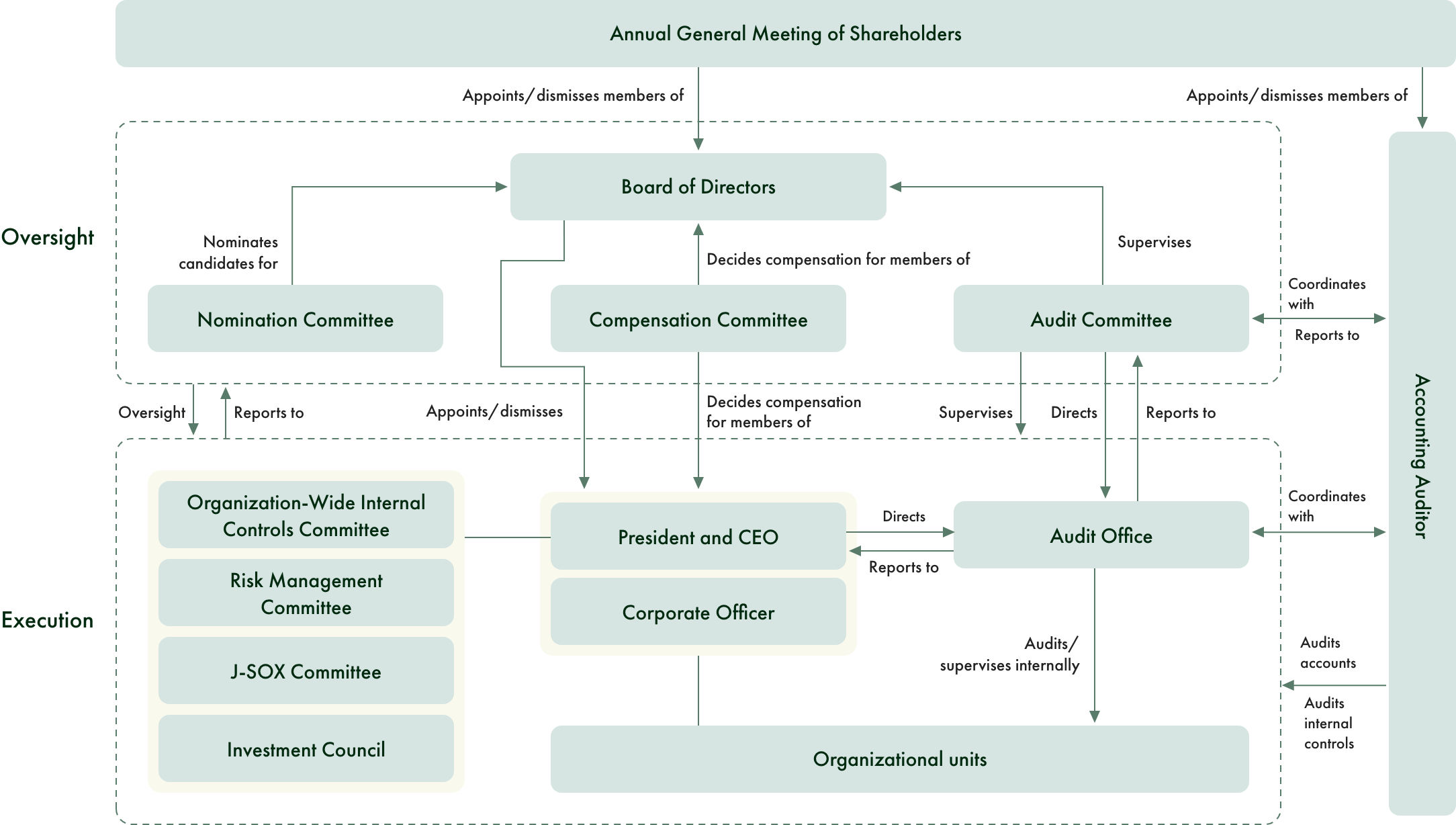
Risk Management Structure

Risk Assessment Process

Outlined below is KOKUYO Group’s risk assessment process for the organization as a whole and for individual business units. The process is spearheaded by the Risk Compliance Committee.

  1. 1.
    Identifying risks
    Corporate and business divisions assess legal and regulatory developments, societal expectations, industrial trends, and business strategies to identify risks and opportunities in environmental, social, and governance categories.
  2. 2.
    Assessing risks and assigning priority level
    The risks identified in 1 are assessed by the likelihood that they will materialize and by the magnitude of the effect on KOKUYO Group’s business and stakeholders if they do materialize.The risks that score high in both measures are classified as major (i.e. high-priority) risks.
  3. 3.
    Conferring on actions to take
    Risk managers of the relevant corporate and business divisions confer on whether the risk in question should be avoided, mitigated, transferred, or accommodated and on what specific measures to take.
  4. 4.
    Monitoring and updating
    The risk managers of corporate and business divisions regularly monitor the progress made in formulating and implementing measures to address the major risks.The set of risks and opportunities are regularly updated to reflect social and business trends so that the process can be continually improved.

Risks Affecting KOKUYO Group and Measures to Address These Risks

Business Risks Identified risks Measures
External Risks
Economic Risks
  • Economic fluctuations in Japan could negatively affect corporate earnings and expenditure on fixed assets.
  • Shift business model from tangibles to intangibles to expand the fields of our existing businesses and develop new businesses
  • Economic uncertainties prevail in China and other important overseas markets.
  • Monitor country- and region-specific risks, go further in overseas expansion and improve coordination with local subsidiaries.
  • US economic policy could have ramifications, as could other region-specific political and economic changes, and regulatory and ESG-related momentum could increase.
Market Risks
  • Market decentralization and digitalization could hamper KOKUYO Group’s efforts to gain and maintain a competitive advantage.
  • Make business structure adaptable to a market changes
  • Labor shortages in logistics and construction could threaten business continuity.
  • Minimize workload in logistics and construction without sacrificing business continuity and growth prospects
Risks Associated with Changes in Fair Value
  • Fluctuations in financial markets reduce the fair value of our investment securities.
  • Regularly assess holdings to determine whether it is worth continuing to hold them; consider selling and offloading holdings
Risks Associated with Natural Disasters and Infectious Disease Outbreaks
  • A major natural disaster could cause a suspension in business activities or a reduction in business activities in Japan or overseas.
  • Regularly review the business continuity plan to ensure it is effective
Risks Related to Business Operations
Compliance Risks
  • A violation of regulatory requirements (related to quality, trade, environment, labor, health and safety, accounting standards, or tax) might be detected or confirmed
  • Continually spread awareness of the KOKUYO Group Code of Conduct
  • Establish KOKUYO Group Anti-Bribery and Anti-Corruption Policy and KOKUYO Group Competition Law Policy
  • Ensure regulatory response by regularly monitoring regulatory developments and compliance with the latest regulations
Quality Risks
  • A product recall could harm our performance and reputation
  • Establish and disseminate KOKUYO Group Quality Policy
  • Implement and operate a quality management system aligned with ISO 9001
Procurement and Environmental Risks
  • Performance may be negatively affected by fluctuations in raw material prices and exchange rates.
  • Financial health may be damaged by such.
  • Deficiencies in ESG could harm our performance, financial health, or reputation.
  • Use forward exchange agreements, optimize local procurement ratios, and diversify suppliers
  • Establish the Regulations for the KOKUYO Group Sustainable Procurement Policy and the Regulations for the KOKUYO Group Sustainable Standards to promote mutual business growth with supply-chain partners
Talent and Labor Risks
  • Delays in attracting and training talent could stunt business growth.
  • An occupational accident or employee health issue could harm our performance, financial health, or reputation.
  • Establish the Talent Management Policy and the KOKUYO Academy (a talent development organization) to expedite investments in talent development
  • Promote diversity and inclusion by establishing the Regulations for the KOKUYO Group Human Rights Policy and the Regulations for the KOKUYO Group Health and Productivity Management Declaration, by expanding anti-harassment training (adding content on non-toleration of abusive customers), and by making the workplace accommodative toward people with disabilities
  • Consider establishing a manual setting out global safety standards (covering workplaces in and outside Japan)
  • For KOKUYO Group Hotline in Japan, connect the hotline to an external whistleblowing service and extend coverage to suppliers
Information Security Risks
  • Performance could be negatively affected by a virus or cyberattack that causes system stoppage or by the leakage of sensitive information or customers’ personal data.
  • If our business profile changes or expands beyond the coverage of our existing workflows and core IT systems, the coverage gap may impede productivity or internal controls
  • Improve system failure detection and defenses against viruses and other cyberthreats, back up data regularly
  • Set rules on the handling of customer and personal data, inform employees about information security risks
  • Consider revising business processes and updating core system
AI risks
  • AI has ethical risks such as leakage of sensitive or personal information and other privacy violations.
  • Draft an internal policy on the use of AI and develop plans for AI governance
Investment Risks
  • Macroeconomic changes could harm the performance or financial health of companies in our investment portfolio.
  • Consult outside experts during the investment vetting process, keep improving the monitoring process
Risks Related to Effective Use of Real-Estate
  • Changes in the external business environment could, along with other changes, negatively affect the value of our real-estate holdings.
  • Offload non-business assets to improve efficiency of real-estate and net cash
Scrollable