Social
WELLBEING AMONG EMPLOYEES
To help improve wellbeing, we will promote work-life balance, new workstyles, and a diverse workplace (inclusive of gender, disability, and nationality) that produces innovation. As a pioneer of new and better workstyles and lifestyles, we both propose new workstyles and embrace diversity, inclusion, and innovation in our own workplaces so that our employees will feel engaged and bring their authentic selves to work.
Actions
[Workstyle reform]
- KOKUYO-Style Hybrid Work
- Shift to Mindset that Values Employees' Disposable Time
- Programs for Workplace Diversity
- Enabling Work-Life Balance
- Flextime in Distribution Centers
- Partnerships with External Organizations
[Diversity and Inclusion]
- Employing People with Disabilities
- Embracing Diversity
- Helping Employees Build Diverse and Fulfilling Careers
Workstyle Reform
KOKUYO-Style Hybrid Work
In 2022, we launched KOKUYO-Style Hybrid Work. This program honors diversity while encouraging employees to engage in workstyles that improve the productivity and creativity of the team as a whole, so that personal growth can accompany team outcomes. KOKUYO’s distinctive workstyle model is practiced by supporting each employee’s “life-based working,” a term we use to describe a situation in which the one’s workstyle, learning style, and lifestyle are balanced and embody one’s uniqueness
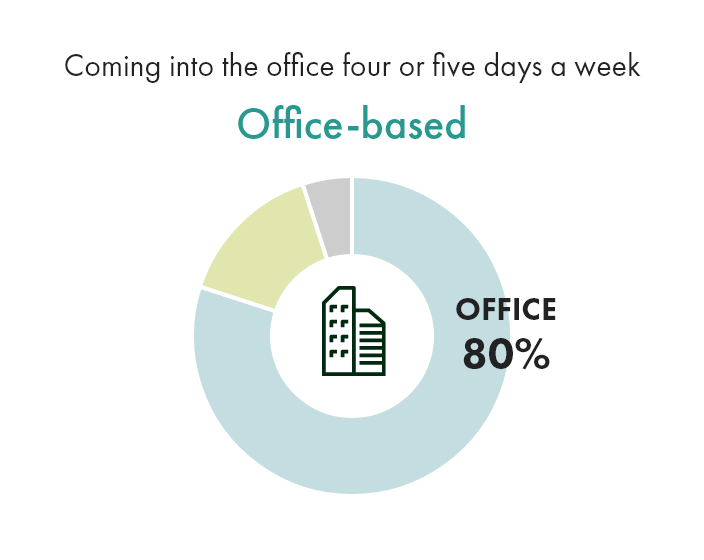
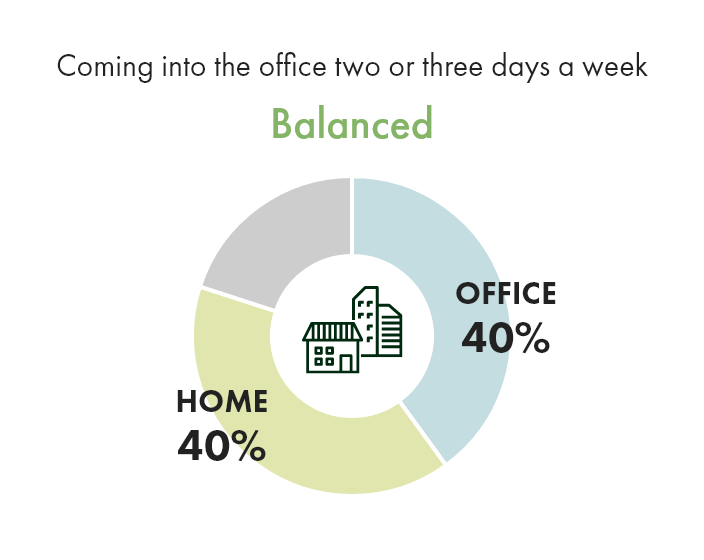
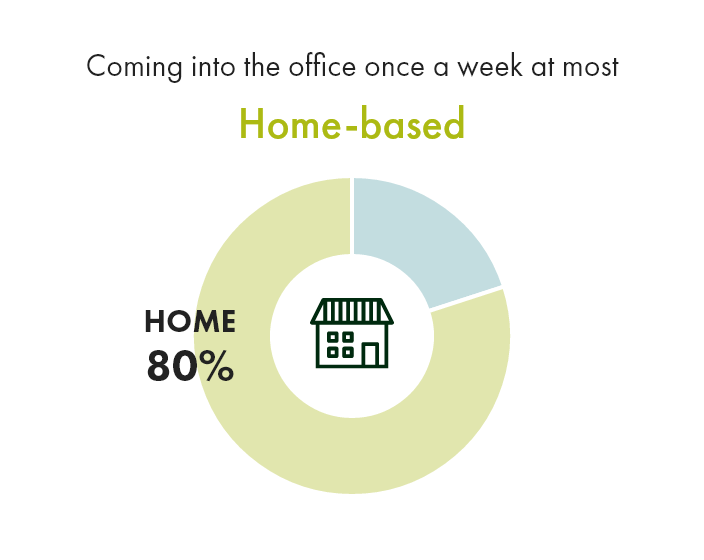
For example, employees choose one of three workstyle categories (office-based, balanced, home-based) and then decide with their superiors on a workstyle that will best suit their individual and team performance. Teams regularly review members’ workstyles to see how they can improve.
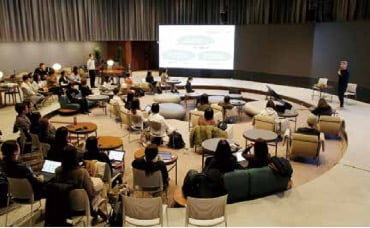
With the workplace expanding, we provide employees with a satellite-style multipurpose space, known as n.5 (pronounced “enu-ten-go”). The space may be used as a satellite office, but it can also be used for activities related to employees’ working, learning, and living. Employees use n.5 for a variety of purposes, including for self-led seminars and other self-organized events.
Shift to mindset that values employees' disposable time
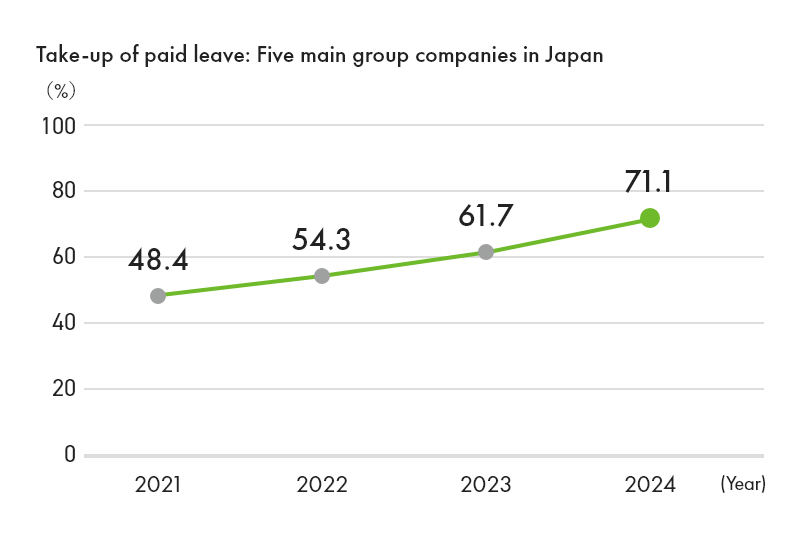
To help employees gain more disposable time, we are transforming employee management with new approach to workstyles and time allocation, focusing on three themes: follow-up process, 1 on 1, and leave support. For the follow-up process theme, team leaders keep track of members’ work with timely follow- ups and then modify work schedules and reallocate resources as necessary. This process helps standardize workflows and improve efficiency at each organizational unit. Alongside this, we have set days for which we encourage employees to take paid leave and encourage employees and their supervisors to hold dialogues about strategic take-up of leave. Such dialogue will only be effective if there is an open organizational culture, enabling transparency in relationships. We have examined the kind of 1-on-1 sessions that best suit our organization (the frequency of the sessions, the settings in which they are held, and the tools used), resulting in the KOKUYO 1-on-1 model, which we have rolled out across our organization. We also hold communication events across divisional boundaries.
We are also actively committed to reforming workstyles in the logistics industry. KOKUYO Supply Logistics and KOKUYO Logitem have introduced flextime for distribution center staff and all other employees. With flextime, employees exercise autonomy in deciding which hours they work according to busy and slow periods. This contributes to wellbeing by freeing up disposal time and by reducing physical and mental strain.
Programs for Workplace Diversity*
We are going further to support the careers of diverse employees and accommodate their needs associated with each life stage.
| Maternity leave | Pregnant employees are entitled to a leave of absence for a period lasting from six weeks before the due date (14 weeks if a multiple pregnancy) to eight weeks after it. |
|---|---|
| Spouse’s leave | Employees whose spouse is pregnant are entitled to two days’ leave around the due date. |
| Parental leave | Employees are entitled to a leave of absence to care for their children until the child’s 2nd birthday (if the child’s second birthday falls in April, until the end of that April). |
| Sick child leave | If employees have any children who have not yet graduated from grade 6 of elementary school, they are entitled to five days of leave a year or, if they have multiple applicable children, 10 days of leave a year (the leave can also be taken on an hourly basis). Taking such leave has no impact on wage or bonus. |
| Nursing care leave | Employees are entitled to take, for each care dependent, up to three periods of leave totaling no more than 183 days. |
| Short nursing care leave | Employees are entitled to take, for each care dependent, five days of leave a year or, if they have multiple care dependents, 10 days of leave a year (the leave can also be taken on an hourly basis). Taking such leave has no impact on wage or bonus. |
| Shorter hours | Employees with children are entitled to take shorter work schedules until the children complete grade 3 of elementary school.Employees who are caregivers to dependents with long-term care needs are entitled to take shorter work schedules for up to three years per dependent. |
| Wellness leave | This is an updated form of menstrual leave. It now covers employees who require leave for menstrual pain or maternity checkups and to men and women who require leave for infertility treatment. |
| KOKUYO-Style Hybrid Work | We promote a mixture of home and office working. |
| Complete flextime (with no predetermined core period) | We encourage employee productivity with flexible work hours. |
| Re-employment system for employees who voluntarily resigned | We run a returnship program to help reintegrate into the workplace regular employees who resigned because of marriage, childbirth, childcare, nursing care, spouse relocation, overseas study, charity work, a career change, or other valid personal reasons. We believe that bringing in outside experience and insight further increases the diversity of our organization. |
| Re-employing mandatory retirees | We have in place a system that, in principle, allows employees who wish to work at the KOKUYO Group after retiring at the mandatory age of 60 to continue working as senior employees. Through this initiative, the retirees get opportunities to continue a professional role in society after mandatory retirement. In return, they use their experience and knowledge to help younger colleagues develop. |

-
※These programs apply in KOKUYO and major subsidiaries.
-
※Related information:View data on numbers of employees taking childcare and nursing care leave
Enabling Work-Life Balance
The KOKUYO Group endeavors to create an employee-friendly working environment with consideration for the work-life balance. These initiatives have been recognized. Three companies* in our group have acquired the Kurumin Mark. The Kurumin Mark certifies that the company or organization in question is an active supporter of working parents. The certification system is run by the Ministry of Health, Labour and Welfare as part of the ministry’s efforts to address the nation’s declining birthrate. It is provided for in the Law for Measures to Support the Development of the Next Generation.
-
※The companies which have acquired the Kurumin Mark are KOKUYO Co., Ltd., Kaunet Co., Ltd., and KOKUYO Marketing Co., Ltd.
Flextime in Distribution Centers
The distribution industry faces a number of labor challenges. For example, restrictions on truckers’ overtime will come into effect in Japan in 2024. To address the challenges, KOKUYO Group has embraced workstyle reform. It is generally believed that flextime is unfeasible for the distribution industry. Nonetheless, KOKUYO Logitem introduced flextime for back-office staff in 2009 and then for distribution center staff in 2022. As well as prompting a higher uptake of flextime in delivery operations, KOKUYO Logitem has set a best-practice model for the industry. In 2023, KOKUYO Supply Logistics introduced flextime for distribution center staff and all other employees. With flextime, employees exercise autonomy in setting their work schedule according to the level of work demand. This frees up disposable time and reduces physical and mental strain. It also sets a good example of flexible workstyle practices for the industry.
-
※Related information: KOKUYO Logitem’s news page*
-
※Related information:KOKUYO Supply Logistics’ news page*
-
- *Japanese Only
Partnerships with External Organizations
In 2023, KOKUYO earned an award from the Japan Telework Association, an organization dedicated to promoting telework as a workstyle that uses digital technology to remove restraints of time and place. In an effort to explore new work options, we participate in a public-private council on telework and workations. The council was established to promote workations and build up the number of workation practitioners. We have been member of the Iku-boss Corporate Alliance (Sponsored by Fathering Japan) ever since the program began in December 2014. Members of this alliance share best practices for ensuring that leaders, in their efforts to empower the employees and deliver positive outcomes for the organization, are sensitive to employees’ need for work-life balance. Through our membership of the alliance, we gain opportunities to rethink approaches to diversity management and organizational culture.
Diversity and Inclusion
Employing People with Disabilities
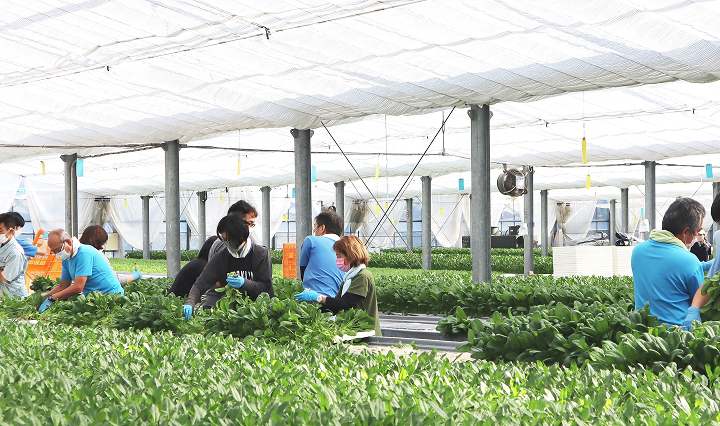
KOKUYO has been an active employer of people with disabilities ever since 1940. In that year, KOKUYO started recruiting students from a school for the deaf in Osaka (now known as Chuo School for the Deaf). The students were employed in the company’s factory in Imazato, which stood on the site of what is now our Head Office. A turning point in our policy for employing people with disabilities came in 2002, when we unveiled a program of structural reform. This reform program involved spinning off our business units into new companies. A question we then faced was how to provide jobs in the new group companies for people with disabilities. In September 2003, we founded KOKUYO K Heart Co., Ltd. as a “special subsidiary” (meaning a disability-friendly employer that is counted as part of the parent company). In December 2006, we founded Heartland Co., Ltd., a subsidiary devoted to employing people with intellectual or mental disabilities. As of June 1, 2024, people with disabilities make up 2.55% of the group’s workforce.
-
※Related information:Employees composition (employees with disabilities)
Embracing Diversity
Believing that talent diversity is essential to creativity, we maintain a rough gender parity when hiring fresh graduates and actively hire people who already have career experience. The Campus (our office in Shinagawa, Tokyo) embraces diversity and inclusion. It has an all-gender bathroom that LGBTQ+ people or anyone can feel comfortable using. It also has a nursing room (accessible to men as well as women) and a multi-faith prayer room.
To help empower diverse talent, we operate the KOKUYO Academy, a talent-development institution that focuses on training up leadership talent to manage our businesses.
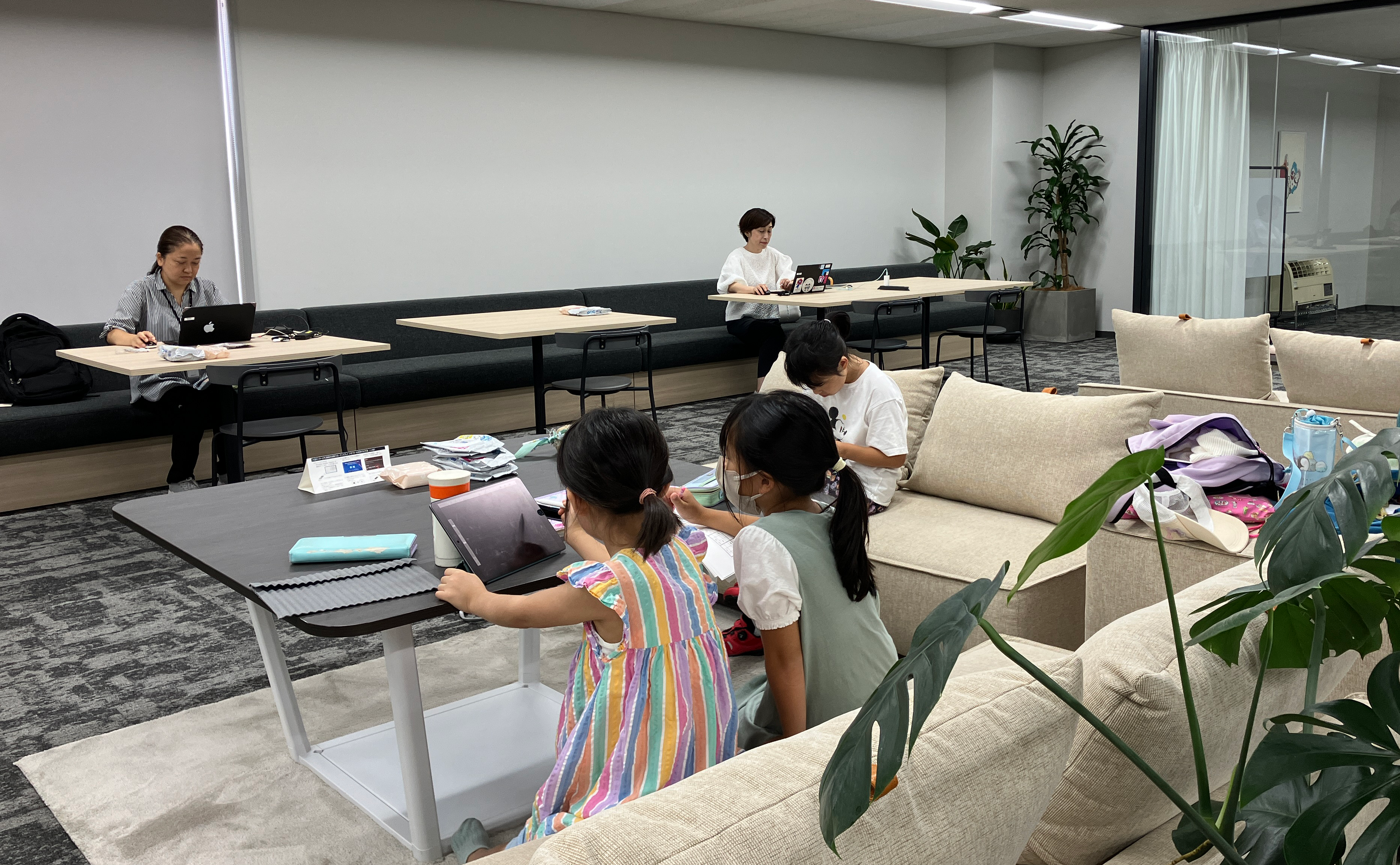
As part of our efforts to provide a workplace in which employees with family care needs feel supported, we have updated our support measures for balancing career with family care commitments, provided an in-office playschool for when schools break for spring and summer, and allowed the option to bring children to the office. We are verifying real changes in the workstyles of such employees.
Helping Employees Build Diverse and Fulfilling Careers
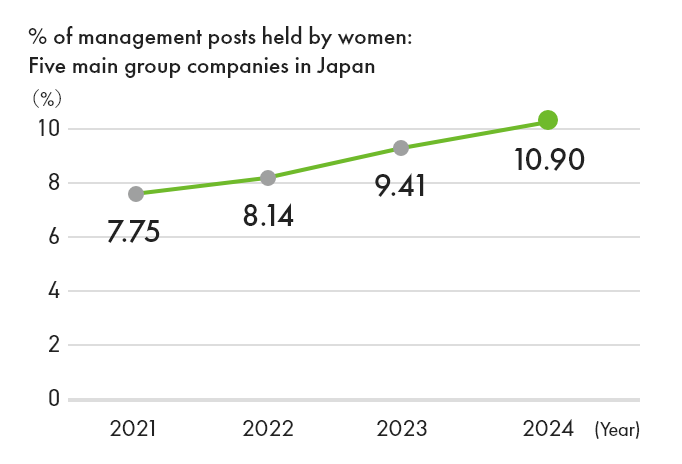
Among our metrics for measuring empowerment of diverse employees in the workplace is a material goal: 16% of management posts to be occupied by women in 2027.
We also provide support measures to help employees balance work with family care commitments. Such support helps prevent the career bottleneck that employees can experience when they take time away from work to look after children or care for an elderly relative. We extended the coverage of leave to care for a sick or injured child so that employees can now use it until their child is in the sixth grade of elementary school. We also relaxed the requirements for family care leave. Additionally, we offer the new workstyle option of bringing their children to the workplace.
We organize a Life & Career Day. The event features talks by guest speakers from pioneering companies about balancing work with parenting, encouraging men to take paternity leave, and other topics. It also features a panel discussion by employees.
For junior employees, we have KOKUYO Career Dock. KOKUYO Career Dock includes two programs run simultaneously. One is a self-development program for the junior employees. The other is a program for training subordinates attended by the employees’ supervisors. KOKUYO Career Dock is designed to foster a common understanding between supervisors and subordinates about career growth and challenge-taking. The training programs are also attended by senior managers to encourage the junior employees to commit to professional development and their supervisors to support their development.
We will continue to help employees develop their potential and forge fulfilling careers.