ENVIRONMENT
ENVIRONMENTAL MANAGEMENT
KOKUYO recognizes that environmental problems, including global warming and the reduction of forest resources, are pressing issues. We will bring together the best business brains to develop sustainable solutions.
Environmental Management Goals and Results for 2024
| Environmental Policy | 2024 goals and results | Score | |
|---|---|---|---|
| Goals | Results | ||
| Respond to the climate crisis * Domestic consolidated subsidiaries, KOKUYO K Heart Co., Ltd., Heartland Co., Ltd. |
Reduction of CO2 emissions Total year-on-year change in volume: +12.8% (when production is excluded: -1.1%) |
Year-on-year change: +16.1% (reduction efforts changed emissions by -0.4%) |
× |
| Reduction of unit energy consumption Year-on-year change: -1.0% |
Year-on-year change per unit of sales: -2.5% | 〇 | |
| Contribute toward a circular economy | Improve recycling rate in relation to total waste volume
|
|
〇 |
| Maintain eco x zero | Maintained | 〇 | |
| Widening the scope of empathy,collaboration, and co-creation | Publication of CSR report 2024 | Publication of CSR report 2024 | 〇 |
| Ensuring robust management | ISO 14001 : 2015 Recertification audit |
Results of surveillance audit
|
× |

Policy
KOKUYO Group Environmental Policy
To build a “sustainable society,” it is necessary to implement integrated activities aimed at achieving a decarbonized society, a circular economy, and a nature-positive society. The KOKUYO Group Environmental Policy sets out specific actions to that end. The policy is updated yearly. Following an update in April 2025, the policy identifies four environmental challenges: 1) responding to the climate crisis, 2) contributing to a circular economy, 3) contributing to a society that coexists with nature, and 4) legal compliance and pollution prevention. The first three are material issues, while the fourth was already part of our policy on protecting the environment. It also sets out three types of actions, which align with our code of conduct: 1) unleashing creativity and innovation, 2) widening the scope of empathy, collaboration, and co-creation, and 3) ensuring robust management. The policy was further updated in December 2025 to clarify our commitment to net zero. Guided by this policy, each operating company sets its own environmental target, taking into account the nature of its businesses, and then takes actions to improve its environmental performance.
KOKUYO Group Environmental Policy
A healthy global environment is an essential foundation for work, learning, and daily life. The Kokuyo Group recognizes global environment issues such as climate change, depletion of resources, loss of biodiversity, and pollution as perpetual issues shared by the whole world. We will assume the lead in taking action to resolve these issues by bringing together the wisdom of various people involved in our business activities.
■Environmental challenges
-
1.Responding to the climate crisis
To support the net-zero transition, we will work toward net-zero greenhouse emissions throughout our supply chains by shifting fully to renewable energy, committing to energy efficiency, and engaging in environmental conservation initiatives that increase carbon sequestering. -
2.Contribute toward a circular economy
To support the transition to a circular economy, across our supply chain, we will use less resources, recycle more waste, develop products and services that are recycling-friendly in each stage of their life cycle, and pitch ideas for waste-free lifestyles, contributing to a waste-free world. -
3.Contribute toward a society that coexists with nature
To help restore biodiversity and other forms of natural capital, we commit to legal, transparent, and sustainable procurement of forest resources. To minimize negative impacts to ecosystems, across our supply chain, we will reduce the use of harmful chemical substances, improve resource productivity, and use water more efficiently. -
4.Legal compliance and pollution prevention
As well as complying with environmental regulations by country and region, we will follow the environmental policies set out in industry guidelines we have endorsed, meet stakeholders’ expectations regarding the environment, and adhere to global environmental initiatives we have endorsed. We also strive to prevent air, water, and soil pollution.
■Actions
-
5.Unleashing creativity and innovation
We will contribute toward solving the environmental issues of local communities and society in general by proposing environmentally sustainable products and services along with channeling our creativity toward technological pursuits, workstyles, and lifestyles that improve environmental performance. -
6.Widening the scope of empathy, collaboration, and co-creation
To collaborate with a wider body of stakeholders in protecting the environment, we will communicate our environmental commitments and performance with customers through active disclosures of our environmental data, endorse more global environmental initiatives, and work closer with industrial associations and stakeholders. -
7.Ensuring adaptable management
To ensure sustain positive environmental impacts, we commit to an ongoing cycle for improving environmental management. This includes setting policies and targets and improve environmental performance. It also includes building and applying a database of knowledge and best practices and educating employees in such.
Revised Date: December 1, 2025
KOKUYO Co., Ltd.
Director,
Representative Corporate Officer,
President and CEO
Hidekuni Kuroda
Processes in place
Obtaining ISO 14001 certification
Seventy-four (approximately 50%) of the 155 sites in KOKUYO and its consolidated subsidiaries have received ISO 14001 certification.
Sites with ISO 14001 CertificationEnvironmental Management System (EMS) (Japan)
Our Environmental Management System (EMS) is certified to ISO 14001. It consists of an integrated accreditation system for planning, R&D, production, marketing, sales, services, storage, and shipment. Since 2004, the system has covered KOKUYO and all major subsidiaries in Japan. While keeping the core elements of the EMS consistent across the group, we differentiate according to the scale of the environmental impact. Specifically, operating companies and plants with a relatively large environmental impact get case-specific treatment, while those with less environmental impact get standard treatment. We also try to give the companies sufficient leeway to manage their environmental impacts in a manner that suits the nature of their businesses. For example, we allow the companies to set environmental targets in line with their business strategies.
Previously, our environmental initiatives were led by the Environment Committee. This committee coordinated efforts to address environmental issues and monitored socioenvironmental trends. However, we later decided that a more group-wide approach was necessary to deal with the increasingly diverse and complex environmental issues in Japan and around the world. In 2022, we reorganized the committee into a subcommittee (Environmental Subcommittee) of the new Sustainability Committee and increased its membership to include Actus (our interior retail business) and Heartland Co., Ltd. (a special subsidiary—a company focused on employing people with disabilities). The Environmental Subcommittee has three taskforces for leading cross-organizational efforts to accomplish the goals for the three material issues: the Climate Crisis Taskforce, the Circular Economy Taskforce, and the Taskforce for Coexistence with Nature.
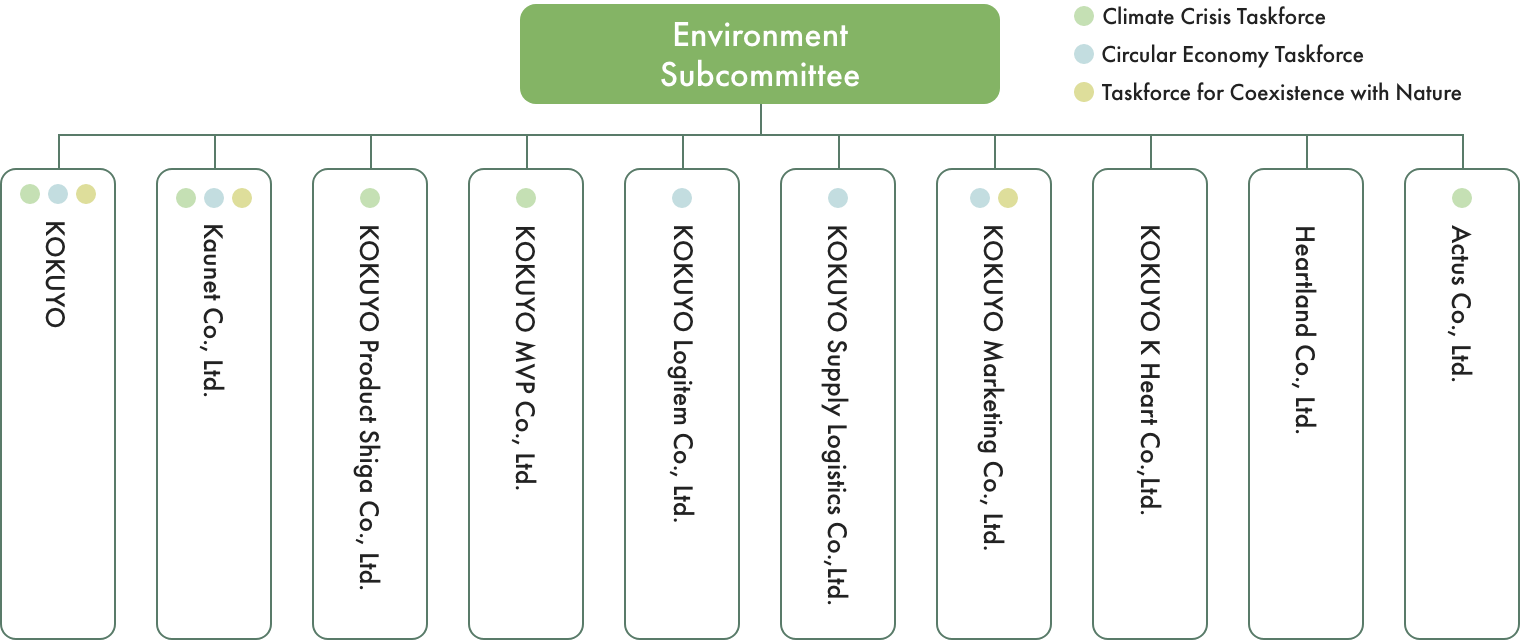
for material issues
Three taskforces
Climate Crisis Taskforce
- KOKUYO
- Kaunet Co., Ltd.
- KOKUYO Product Shiga Co., Ltd.
- KOKUYO MVP Co., Ltd.
- Actus Co., Ltd.
Circular Economy Taskforce
- KOKUYO
- Kaunet Co., Ltd.
- KOKUYO Logitem Co., Ltd.
- KOKUYO Supply Logistics Co., Ltd.
- KOKUYO Marketing Co., Ltd.
Taskforce for Coexistence with Nature
- KOKUYO
- Kaunet Co., Ltd.
- KOKUYO Marketing Co., Ltd.