Environment
Disclosures aligned with the TCFD recommendations
Governance
In 2022, the KOKUYO Group endorsed the recommendations of the Task Force on Climate-related Financial Disclosures (TCFD). We regard climate change as a major strategic concern and have established an organizational framework for managing climate-related risks. Under the supervision of the Board of Directors, the Sustainability Committee identifies climate-related risks so that the management can incorporate the information into strategic planning and take the decisions and actions necessary to mitigate the risks. The Sustainability Committee manages and monitors climate-related and other important sustainability matters in an integrated manner. To supervise this process effectively, the Board of Directors hears reports from the committee at regular intervals and then deliberates on nature-related risks and other sustainability issues. The committee seeks board approval on any significant risk, opportunity, strategy, or policy, allowing board oversight over such matters.
The Sustainability Committee’s membership consists of corporate officers and managing officers. It is chaired by the “Director, Representative Corporate Officer, President & CEO” and its secretariat is headed by the managing officer in charge of sustainability. The Committee monitors social and environmental trends to identify strategic concerns related to sustainability. It then formulates action plans and allocates budgetary resources for addressing these concerns. One of the Sustainability Committee’s subcommittees is the Environment Subcommittee. This subcommittee identifies climate-related risks, incorporates the findings into strategic planning, and spearheads organization-wide efforts to mitigate the risks.
Strategies
We use scenario analysis to identify climate-related risks and opportunities and their financial implications so that the necessary measures can be taken. Since 2030 is the endpoint for our long-term vision, our scenario analysis projects climate-related shifts in society and among stakeholders between now and that endpoint. Through FY2022 we conducted scenario analysis for the following businesses: furniture and business-supply distribution in the workstyle field, and stationery and interior retail in the lifestyle field.
Scenario Analysis
| Scenario | Overview | Main reference scenarios |
|---|---|---|
| Within 1.5℃ | Net Zero Emissions by 2050 Scenario (“NZE Scenario”: a possible future pathway toward the goal of limiting global warming to below 1.5 °C relative to preindustrial times): Government regulation is tougher compared to that in the 4 ℃ scenario, and people take a greater interest than they do at present in climate change and other environmental issues. |
|
| 4 ℃ scenario | Stated Policies Scenario (“STEPS”: a scenario that takes into account policies that have been adopted and those that have been announced for adoption in the future): Government regulation is weak compared to the 1.5 ℃ scenario. GHG emissions may increase for a time, and people’s interest in climate change and the environment remains as it is now. |
|

Risks and Opportunities
< Workstyle Field >
| Scenario | Furniture Business |
|---|---|
| Within 1.5℃ | With growing pressure around the world for a net-zero transition, our customers, suppliers, and other social stakeholders will take more action to contribute to the net-zero transition and to reduce waste. The financial/business risks include higher CO2 emissions costs, the need for more capital spending, higher raw material costs, and a decline in net sales following changes in customers’ needs. The opportunities include the potential for developing goods and services to cover shifting customer needs and behavior, and the potential to expand business domains by developing low-emissions businesses. Accordingly, we will seize the opportunity to develop new products and services so that we can create value suited to the changes among customers and in society. |
| 4 ℃ scenario | Timber prices rise amid the global spread in consumer activism coupled with climate impacts. Manufacturing and transportation become increasingly vulnerable to climate-related disaster risks. The financial/business risks include higher raw materials costs and the risk that hiking sales prices to absorb the cost increases may cause a drop in demand for furniture products. Where physical risks materialize, the risks include opportunity losses, business suspension, and the cost of responding to the incident. We will address the risks by increasing our organization’s resilience. We also eye opportunities in the changing market trends, including the rise of disaster management efforts and new workstyles in our customers’ offices. To capture these opportunities, we will develop new solutions that create value. |
| Scenario | Business-Supply Distribution Business |
|---|---|
| Within 1.5℃ | As the net-zero transition progresses, customers, distributors, and other social stakeholders take more action to contribute to the net-zero transition and to reduce waste. The financial/ business risks include the costs of carbon taxes, higher transport costs, and a decline in net sales following changes in customers’ needs. The opportunities include the potential to increase sales revenue with a lineup suited to the shifting customer needs. Accordingly, we will seize the opportunity to change our product lineup and expand our digital measures so that we can increase our climate resilience and create value suited to the changes among customers and in society. |
| 4 ℃ scenario | Raw material prices rise amid the global spread in consumer activism coupled with climate impacts. Physical risks materialize, disrupting transportation and other parts of the supply chain, which may have severe ramifications for the business model. The financial/business risks include higher costs, both for raw materials and for transportation. Where physical risks materialize, the risks include opportunity losses, business suspension, and the cost of responding to the incident.To address the risks, we will strengthen our organization’s resilience by altering our procurement strategy and expanding digital measures. |
< Lifestyle Field >
| Scenario | Stationery Businesses |
|---|---|
| Within 1.5℃ | The global net-zero transition leads to new consumer and market trends, with consumers changing their attitudes toward stationery and other consumables and with new workstyles and learning styles emerging. The financial/business risks include higher CO2 emissions costs, higher raw material costs, the costs of added investment, and the risk that the stationery market shrinks amid digitalization. The financial/business opportunities include the chance to create new value by developing products and services for Japanese and overseas markets that cater to the emerging trends. |
| 4 ℃ scenario | Cost pressures increase amid the global spread in consumer activism and the physical impacts of climate change become an increasing threat. The financial/business risks include higher costs in raw materials and energy. Where physical risks materialize, the risks include opportunity losses and the cost of responding to the incident. Financial/business opportunities include a growing demand for stationery in overseas markets. The opportunities can be realized by strengthening resilience, globalizing the supply chain, and expanding in overseas markets. |
| Scenario | Interior Retail |
|---|---|
| Within 1.5℃ | The net-zero transition increases pressure to realize ecological sustainability, including reducing the CO2 emissions generated in the life cycle of furniture (from production to disposal). The financial/business risks include higher CO2 emissions costs, higher raw material costs, and the costs of added investment. They also include the risk that people purchase interior goods less frequently out of concern for the environment and the risk of increased competition from furniture rental and subscription services. Financial/business opportunities can be realized by balancing business interests with environmental friendliness, such as by carbon footprint labeling and developing services that reduce furniture waste (e.g. repair services). |
| 4 ℃ scenario | Prices for timber goods and other products rise amid the global spread in consumer activism coupled with climate impacts. The supply chain and retail activities become increasingly vulnerable to climate-related disaster risk. The financial/business risks include higher raw materials costs and the risk that hiking sales prices to absorb the cost increases may cause a drop in demand for furniture products. Where physical risks materialize, the risks include opportunity losses and the cost of responding to the incident. We will alter our procurement strategy and develop our e-commerce business to strengthen resilience against these risks, ensuring stable delivery of value. |
Risk management
Climate-related risks are managed by the Environment Subcommittee (a subcommittee of the Sustainability Committee). Guided by the findings of regular internal and third-party research, this subcommittee identifies and evaluates the risks with the participation of managers responsible for each business division.Once the risks are identified and evaluated, they are communicated to the business divisions concerned. The strategic implications of the risks are incorporated into strategic planning by the Sustainability Committee, while business-specific implications are addressed by the relevant business divisions.For groupwide risk management, the Risk Management Committee has been organized to steer efforts across the corporate group.
To integrate climate-related risk management into this existing system for groupwide risk management, the Risk Management Committee will now coordinate with the Sustainability Committee’s Environment Subcommittee.Specifically, the Environment Subcommittee will inform the Risk Management Committee about important matters concerning risk management and the state of compliance with environmental laws and regulations.
Metrics and Targets
Committing to reach carbon neutrality by 2050, we take action to reduce emissions caused directly by our business activities (scopes 1 and 2) as well as emissions in the supply chain related to business activities across the KOKUYO Group (scope 3).
Science-Based Targets initiative (SBTi) Certification for Our Greenhouse Gas Emissions Reduction Targets
We have obtained short-term Science-Based Targets initiative (SBTi) certification for the targets listed below as stepping stones for achieving carbon neutrality by 2050.
- Reduce total scope 1 and scope 2 greenhouse gas emissions by 42% between 2022 and 2030
- Reduce greenhouse gas emissions from the scope 3 category “purchased goods and services” by 25% between 2022 and 2030
- By 2028, SBTi goals to be set by suppliers collectively accounting for 12.5% of emissions from purchased goods and services
2027 commitment goal, result in 2025
Goals:
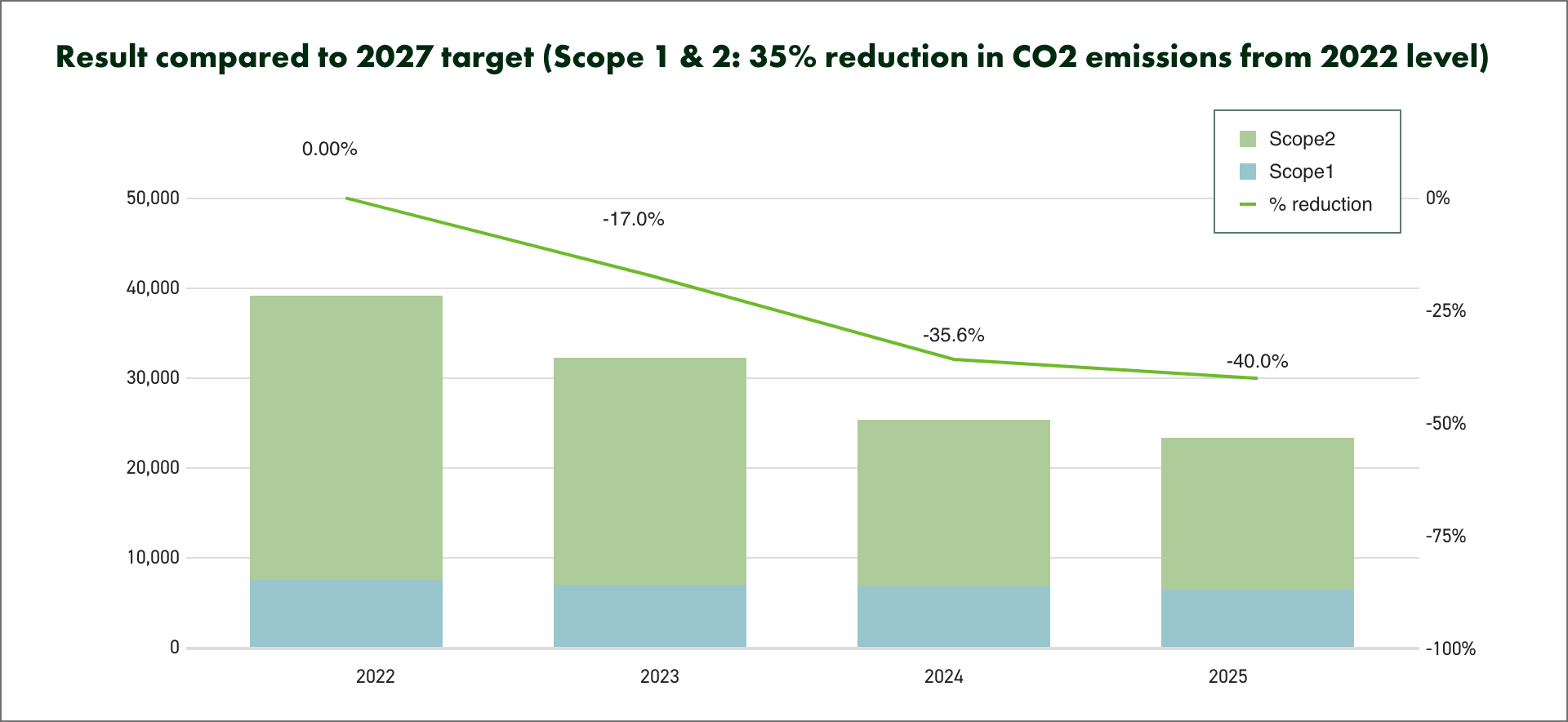
Reduce total scope 1 and scope 2 greenhouse gas emissions by 35% between 2022 and 2027
Result:
In 2025, we achieved this target two years ahead of schedule. In that year, Scope 1 and 2 emissions were 40.0% down from the 2022 level.
-
Note:When calculating reduction, we recalculated past year results on the basis of the scope of consolidation in 2025.
Goal 2:
Formulate an action plan for achieving 2030 scope 3 target (reduce greenhouse gas emissions from the scope 3 category “purchased goods and services” by 25% between 2022 and 2030)
Result:
We asked our paper suppliers to give us primary data showing the emissions per unit of production of the paper we purchase from them, mindful of the fact that much of our Scope 3 emissions are derived from paper production and that we therefore need to engage suppliers in reducing emissions from this source.The paper suppliers were supportive of what we are trying to do and six of them provided the data we requested. We also reached out to six furniture makers in our supply chain and asked them to support us in our efforts to reduce supply chain emissions. They agreed to do so.
Goal 3:
Has suppliers, responsible for 125,000 t-CO2 of our scope 3 emissions, set Science-Based Targets initiative (SBTi) goals
Result:
We conducted a questionnaire survey and interviewed a sample of suppliers accounting for 80% of our procurement spending to understand their current commitment to reducing emissions.The results revealed that the suppliers (including those founded by KOKUYO Group) committing to science-based targets represent 84,800 t-CO2 of our Scope 3 emissions, which is 68% of our target of 125,000 t-CO2.