Environment
Coexistence with Nature: Actions
Sustainable Timber Use
Certifications as a Procurer of Legal and Sustainable Timber
We have been certified as a “procurer of legal and sustainable timber” by the Japan Office and Institutional Furniture Association (JOIFA).In line with the requirements set out in the certification practice statement for Certified Legal Timber Operator system, we engage in practices to ensure that the timber products we use and sell are legal and sustainable. Examples include recordkeeping, assigning dedicated members of staff, and keeping paper trail showing how the timber is used.

How We Have Used Forest Resources in Furniture Products, Due-Diligence Review
In 2025, we used around 9,800 tons of wood in furniture products. This accounts for 17% of all wood we used in products, excluding packaging.Of the wood used in furniture products, 22% consisted of rough-cut lumber that was made into solid wood or engineered wood (including plywood). The remaining 78% consisted of forest residues (byproduct from thinning or clearing) or engineered wood (including medium-density fiberboard and particle board) made from such.Each year, we report such data to JOIFA, the body that certifies us as a “procurer of legal and sustainable timber,” in compliance with the Act on Promoting Green Procurement.As per JOIFA’s reporting guidelines, we try to identify the wood species among the timber we use.
We conduct annual surveys to identify the tree species, usage volumes, and country or region of origin of the wood we use.It is often unfeasible to identify the country or region of origin of the timber used in products, but we do our best to source the products sustainably.
Results of Due Diligence Review of Timber Compliance (in Accordance with Timber Legality Certification Due Diligence System Manual —Furniture Edition)
In 2025 our annual due-diligence review of timber compliance (in accordance with Timber Legality Certification Due Diligence System Manual —Furniture Edition) revealed no potential legal issues with the timber we used.We will continue performing rigorous due diligence while finding ways to further enhance the manual’s effectiveness. You can access the latest version (ver 1.6) using the link below.
Products and Services Embodying Coexistence with Nature
As much as 67% of Japan’s landmass is covered by forests. Forests help prevent sediment runoff, contribute to water retention, and absorb CO2. They also provide a renewable resource.However, in much of the country’s man-made forests, which account for 40% of all the forests, these roles are not fully performed due to insufficient forest thinning.In 1998, we started developing furniture made from thinned timber, releasing it to the market in 2000. By making our office products from Japanese timber that was harvested during thinning operations, we create new demand for wood while also contributing to sustainable forestry.
CASE
Yuimori (Wooden Furniture)
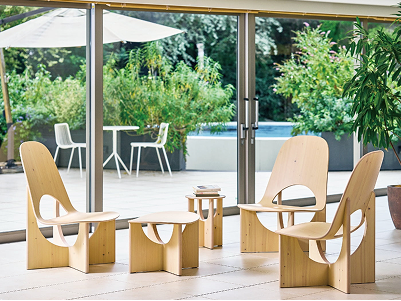
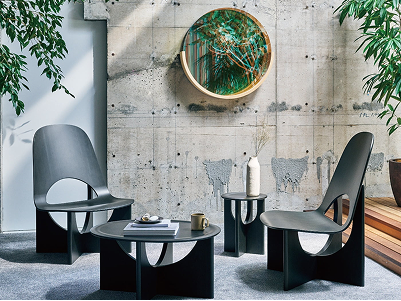
Back in October 2006, we launched the Yui-no-Mori Project in partnership with the Taisho-cho Forestry Association (now the Shimanto Forestry Association) in Kochi Prefecture.More recently, we launched Yuimori, a brand of wooden furniture. The furniture is made from Japanese timber, some of which is harvested in Yui-no-Mori Project. In this way, the project contributes to greater harmony between people and nature.By using Japanese timber, the brand contributes to harmony with nature. Yuimori products feature elegant and impactful designs along with the high quality required for office furniture.They are also designed for sustainable disposal.The products were designed by Keiji Ashizawa, who boasts an extensive design portfolio from architecture to furniture. Furniture experts TENDO CO., LTD. (headquartered in Tendo, Yamagata; represented by Kaoru Moriyama) fabricated the designs, bringing out the timber feel.We contributed our own know-how in office furniture, such as ideas for making a chair comfortable.Through Yuimori, we contribute to greater harmony with nature.
CASE
EF Counter, Featuring Modesty Panels Made from Locally Sourced Timber
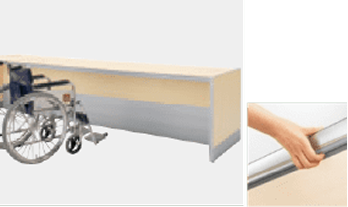
EF Counter is a series of modular counters that can be rearranged to suit changes in the organization or changes in desired use. With their universal design, the counters are friendly to the elderly and to wheelchair users.While part of the structure is made from standardized materials, the modesty panel is made from timber sourced from the locality in question.This arrangement ensures that the counters are no less functional and versatile than standard counters are. The table edge has a groove for securing a walking stick or similar items and a grip for wheelchair users.


CASE
FSC Certification
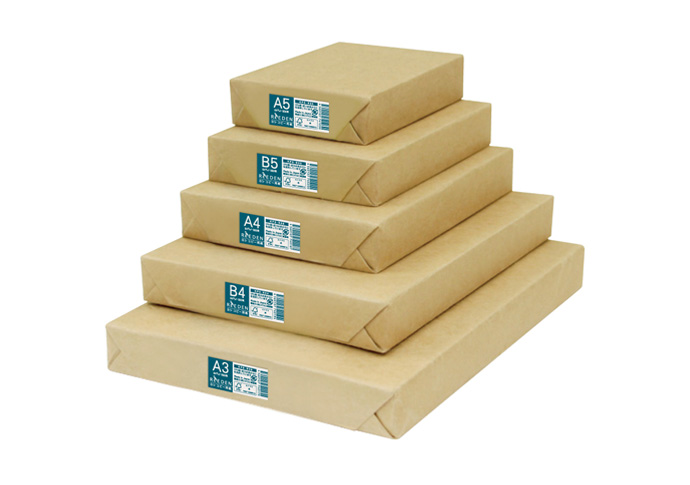
In 2003, we received chain-of-custody (CoC) certification from the Forest Stewardship Council® (FSC).The FSC is an international non-governmental organization that runs a system of third-party forestry certification. Its purpose is to preserve forest environments by promoting a responsible form of forest management that benefits local communities and is economically sustainable.CoC certification applies to the processing and distribution of FSC-certified products.Within our group, KOKUYO, Kaunet and KOKUYO Product Shiga have obtained FSC and CoC certification. Thus, the paper products these companies sell (copy paper, notebooks, and other such products) are FSC-accredited. In 2016, KOKUYO received CoC certification under the Programme for the Endorsement of Forest Certification (PEFC). The PEFC is a forest certification scheme.Its criteria is based on accepted intergovernmental standards.We aim to get more of our products certified for their sustainable use of forest resources. (FSC® C004748).

Environmental Conservation
Yui-no-Mori Project
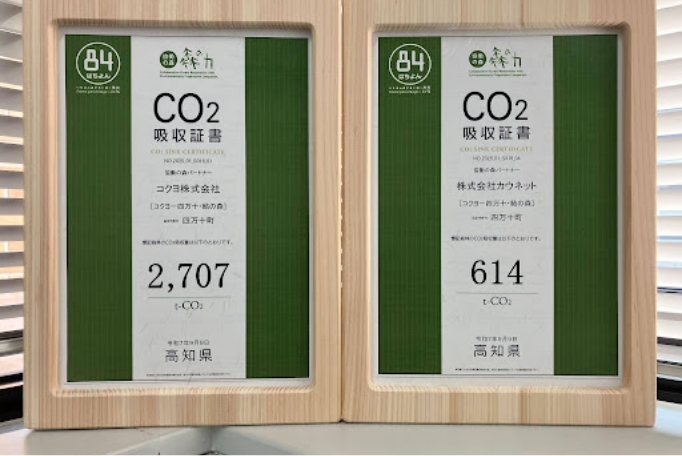
In 2006, we launched a project to conserve a private forest in the Taisho district of Shimanto, Kochi Prefecture, which we named Yui-no-Mori (“linkage forest”). In this project, we thin the forest and make effective use of the resulting timber. Our purpose is to lead the way in reviving manmade forests and restoring the link between the natural environment and local livelihoods. In 2007, the forest-management project was certified by the FSC.Today, Yui-no-Mori has a surface area of 5,425 hectares, and a cumulative area of 2,264 hectares has been thinned.Kochi Prefecture has awarded us the “CO2 absorption certificate” since 2007. In FY2024, the forest absorbed 3,322 tons of CO2. The cumulative total (April 2006 to March 2025) stands at 83,330 t-CO2.The Yui-no-Mori Project has earned the following accolades: In January 2022, it earned the grand prize in the “conservation in practice” category at the Japan Nature Conservation Awards 2022 Nature Conservation Society of Japan; in May 2022, it earned the “excellence award” (Forestry Agency Director-General Award) at Forests × Decarbonization Challenge 2022; in 2020,it earned a “sustainability action” commendation from the Ecological Life and Culture Organization and the “18th Corporate Philanthropy Award” from the Japan Philanthropic Association; in 2019, it won a commendation at the Low Carbon Challenge Cup 2019 and a “minister’s prize” in the corporate category of the 7th Ministry of the Environment’s Good Life Awards; in 2018, it won a “Green Wave Award” prize at the Biodiversity Action Awards; and in 2017, it won the 2017 Japan Wood Design Award.Yuimori (the brand of products made from timber harvested in the Yui-no-Mori Project) was honored at the 6th Eco Pro Awards and at the 2023 Japan Wood Design Award.
Yui-no-Mori ("linkage forest")Kochi Prefecture Confers “CO2 Absorption Certificate”
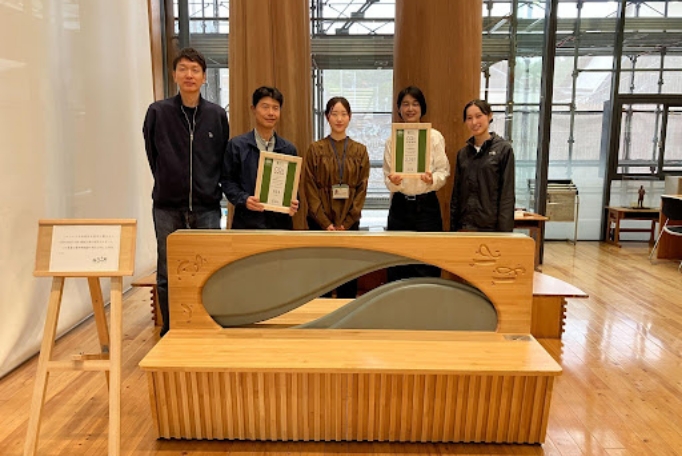
On November 12, 2025, Kochi Prefecture awarded KOKUYO and Kaunet a CO2 absorption certificate in recognition of the fact that we had offset a total of 3,322 tons of CO2 (KOKUYO offset 2,707 tons and Kaunet offset 614 tons). The award ceremony was held in the Shimanto Town Hall.The 3,322-ton offset represented 14% of the group’s total CO2 emissions in 2025 (23,475 tons).This project is an important initiative addressing not only forest conservation but also global warming prevention.
The Project Continues to Receive FSC Certification
Following a regular audit performed on September 30 and October 1, 2025, the project was recertified by the FSC.
Regularly Monitoring Thinning Outcomes
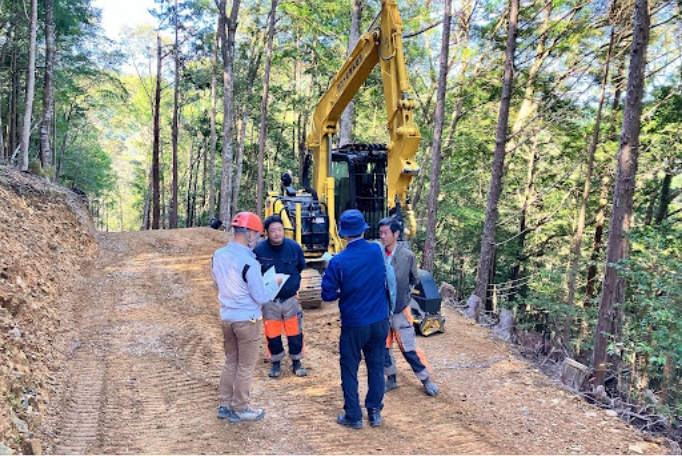
An important part of forest conservation is seeing the outcomes of thinning.We monitor these outcomes over the long term in partnership with the Shimanto municipal government, Shimanto Forestry Association, and Shimanto High School.In 2025, the monitoring survey was conducted on May 20 by Shimanto High School alone owing to poor weather. The vegetation survey was performed as normal on November 11.
Related information: View the latest vegetation survey report from the students of Shimanto High School
ReEDEN Project
The reeds of Lake Biwa play an essential role. They provide an aquatic habitat, support biodiversity, and absorb CO2.In the past, the reeds served as material for roofing and sudare screens, but with the decline of such traditional industries, the reedbeds are no longer maintained so well. The lake once had 260 hectares of reedbeds, but only half remains.In 1992, Shiga Prefecture passed the Ordinance of Reed-Community Conservation to address the problem by conserving, cultivating, and using the reeds.Believing that such action would preserve Lake Biwa’s beautiful environment and fight climate change, KOKUYO Product Shiga has, since 2007, supported this agenda through a conservation initiative and through sustainable use.
Restore the Reeds: The Network for protecting Lake Biwa through reed management
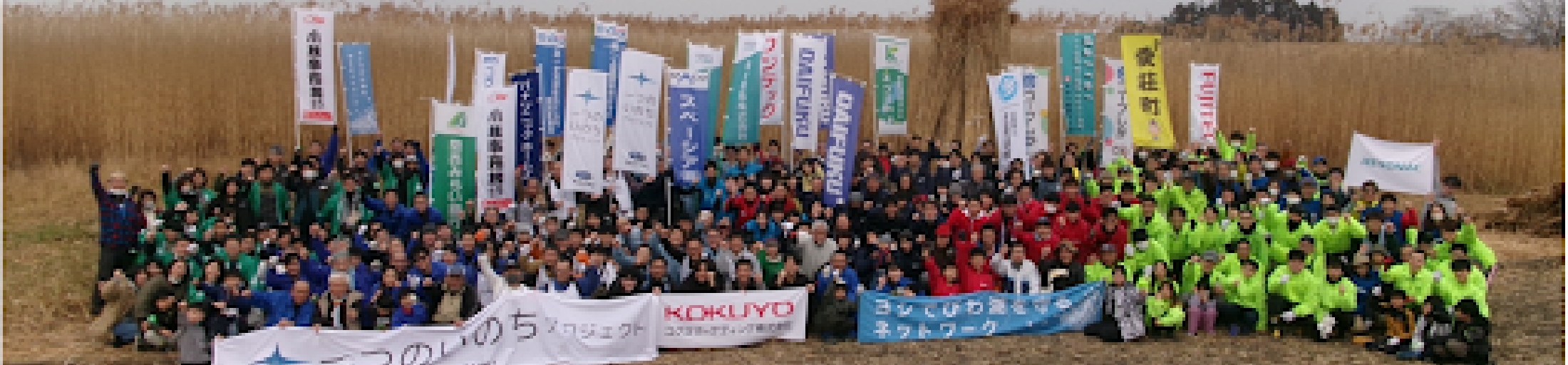
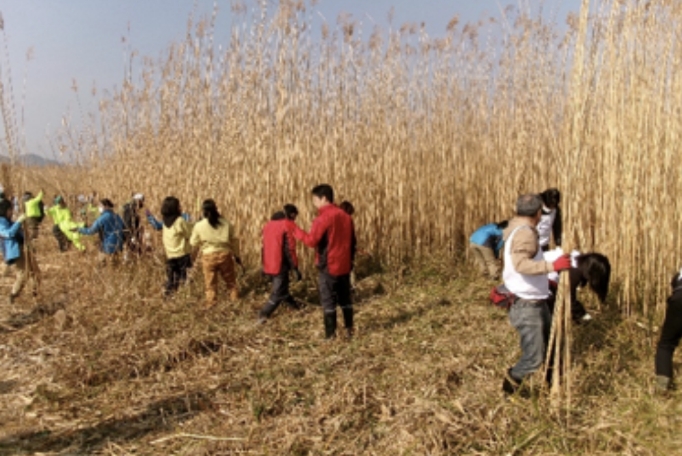
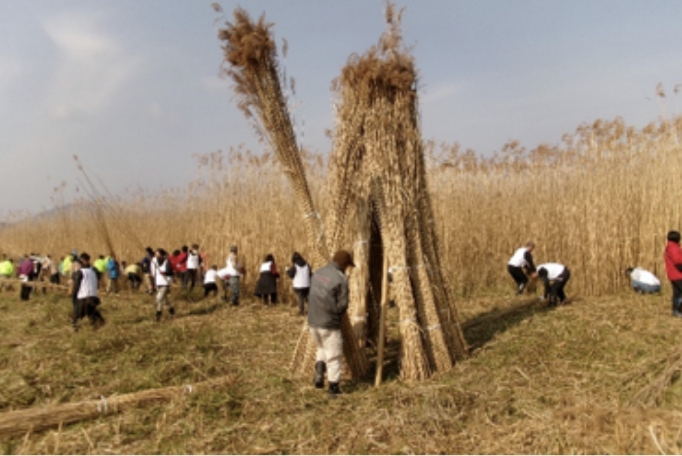
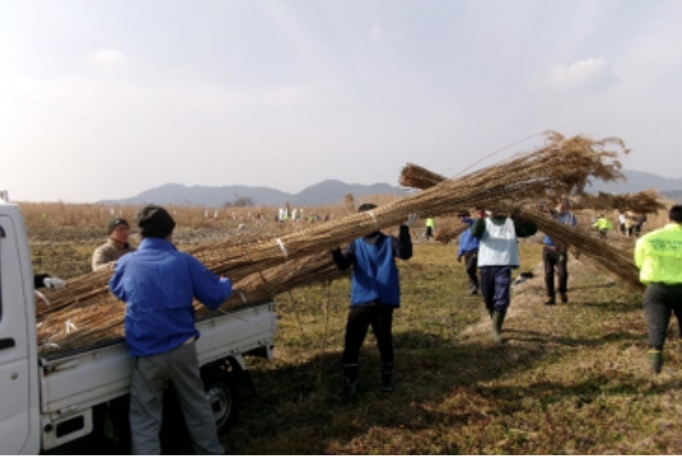
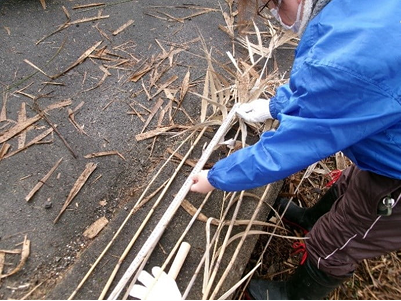
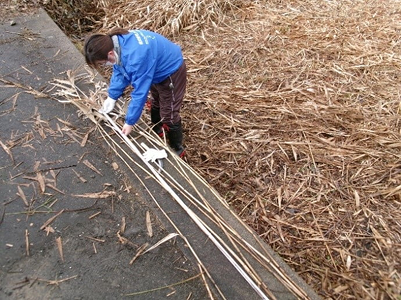
We have formed a network of partnerships for protecting Lake Biwa through reed management. The network had to suspend activities during the pandemic (KOKUYO Project Shiga continued managing the reeds on its own), but it resumed activities in February 2023. Membership of the network has grown amid an ongoing commitment to sustainable-business initiatives and environmental conservation initiatives. This growth is further driven by a growing personal awareness of the importance of environmental initiatives in ensuring a sustainable future. Thus, there is a growing interest in the network’s founding vision, which is for all local stakeholders to act together in addressing a local environmental issue that concerns them all. Now encompassing 135 companies that share the vision, the network holds reed-cutting events twice a year, in January and February. In 2025, it held one in Iba-Naiko in January and the other in Nishinoko in February. Alongside winter reed cutting, the network helps organize and advertise summer events, including a fishing competition to clear away invasive fish species. Reed cutting supports the environment because when the reeds grow, they provide more sequestration and filter impurities from the water to a greater extent. During the pandemic, the reedbed area under management shrunk. Compared to reedbeds that are never trimmed, reedbeds that are periodically trimmed have thicker, longer reeds and thus absorb a greater amount of CO2. To expand the project outward, we have brought on board more stakeholders outside our network of volunteers. As of 2025, 37 activities have been held, with a cumulative total of 6,100 people participating. We will hold more activities in the future.
How Reed Conservation Can Contribute to a Low-Carbon World: Showing the Impact
In biomass surveys, predetermined samples of the reeds are cut from the reedbeds and their length is measured to derive an average length. The average length is then multiplied by the reed-cutting area to determine the amount of carbon dioxide the reedbeds are sequestering. This formula for calculating the CO2 absorption in reeds has been published on Shiga Prefecture’s website.The findings are shared with the organizations and individuals participating in the network to guide their future environmental activities.
In 2025, a single reed-cutting event resulted in the sequestering of 9.17 tons of carbon dioxide over a project area of 6,857 square meters.
There is now a body of evidence to show how the project is contributing toward a low-carbon world.The data has demonstrated that the project is mitigating climate change in addition to improving the lake’s water quality and biodiversity. This knowledge has boosted participants’ motivation and brought more people on board.The project team plans to expand the use of the CO2 absorption tool to encouraging action across the whole of the prefecture. The team’s vision is to follow up the carbon sequestration work in forests across Japan by developing an unprecedented carbon sequestration system for lakeside environments.
Managing Water Risks
Water is an indispensable resource to every individual and organization on this planet, while water-related risks are increasing as the world population grows.Understanding just how vital water is, we are committed to using water as efficiently as possible and to identifying and addressing water risks.
Assessing and Identifying Water Risks
We have assessed the level of water risks in accordance with the recommendations of the Taskforce on Nature-related Financial Disclosures (TNFD).More information is available here (Disclosures Aligned with the TNFD Recommendations).
As yet, we have observed no cases where our business activities resulted in the occurrence of water-related risks, such as water shortages with adverse environmental impacts. Nevertheless, we will continue to collect local information to analyze water risks. Together with that, we will appropriately manage business so that our business activities do not have an adverse effect on the environment.
Compliance with Water-related Laws, Regulations and Standards
We comply with all laws, regulations, and standards that apply where we operate. In FY2025, there were no cases in which we committed a major violation of, or were fined or penalized under, a water-related law or regulation.
Initiatives to Save Water
Of the water used by KOKUYO Group, over 50% is used in Japan.Among the manufacturing processes, steel product painting accounts for much of the water usage.As part of our efforts to save water, Shibayama Plant (Chiba), our main manufacturing plant for office furniture, recycles cleaning water.The cleaning water is evaporated by heat exhausted from a deodorizing furnace. Basically, none of the cleaning water is discharged.Sludge generated during the treatment process is reduced in volume and disposed of appropriately.