Environment
Climate Change: Actions
- Near-term Targets Validated by SBTi
- Calculating Our GHG Emissions Volume
- Creating a Roadmap to the 2050 Target for CO2 Reduction
- GHG Emissions Reduction
- Product CO2 Visualization
SBTi Certification for Our Greenhouse Gas Emissions Reduction Targets
We recognize climate change as a vital management issue. We have positioned “Respond to the climate crisis” as one of our material issues and are working to reduce our greenhouse gas emissions (Scopes 1 and 2 (*1)). The Science Based Targets initiative (SBTi) (*2) evaluated our GHG reduction targets on the road to our 2050 carbon neutrality goal and validated them as science-based near-term targets.
- Reduce total scope 1 and scope 2 greenhouse gas (*3) emissions by 42% between 2022 and 2030
- Reduce greenhouse gas emissions from the scope 3 (*1) category “purchased goods and services” by 25% between 2022 and 2030
- Have suppliers, responsible for 12.5% of our emissions from “purchased goods and services,” set Science-Based Targets initiative (SBTi) goals by 2028
We will expand our emissions reporting to include scope 3 emissions and work with our suppliers to support the carbon transition.
-
*1
- Scope 1: Direct GHG emissions from operations that are owned or controlled by the reporting company (e.g. emissions from the combustion of fuels by the reporting company)
- Scope 2: Indirect GHG emissions associated with the generation of purchased electricity, steam, or heating consumed by the reporting company
- Scope 3: Indirect GHG emissions other than those in scope 2 that occur in the value chain of the reporting company
-
*2Science Based Targets initiative (SBTi)
The SBTi is an international initiative formed in 2015 as a collaboration between four global NGOs: the CDP, the United Nations Global Compact, the World Resources Institute (WRI), and the World Wide Fund for Nature (WWF).It calls on companies to adopt science-based targets for GHG emissions reduction as way of achieving the goals of the Paris Agreement. -
*3GHG stands for greenhouse gases.
Calculating Our GHG Emissions Volume
Calculating GHG Emissions Volume for 29 KOKUYO Group Companies
We are expanding inclusion in the calculation of GHG emissions volume through our business activities as necessary for reducing emissions in our supply chain.
In 2025, we disclosed the estimated emissions of 28 consolidated subsidiaries (including four newly consolidated that year).
Please see the Sustainability Databank on our website for emissions volumes.
Creating a Roadmap to the 2050 Target for CO2 Reduction
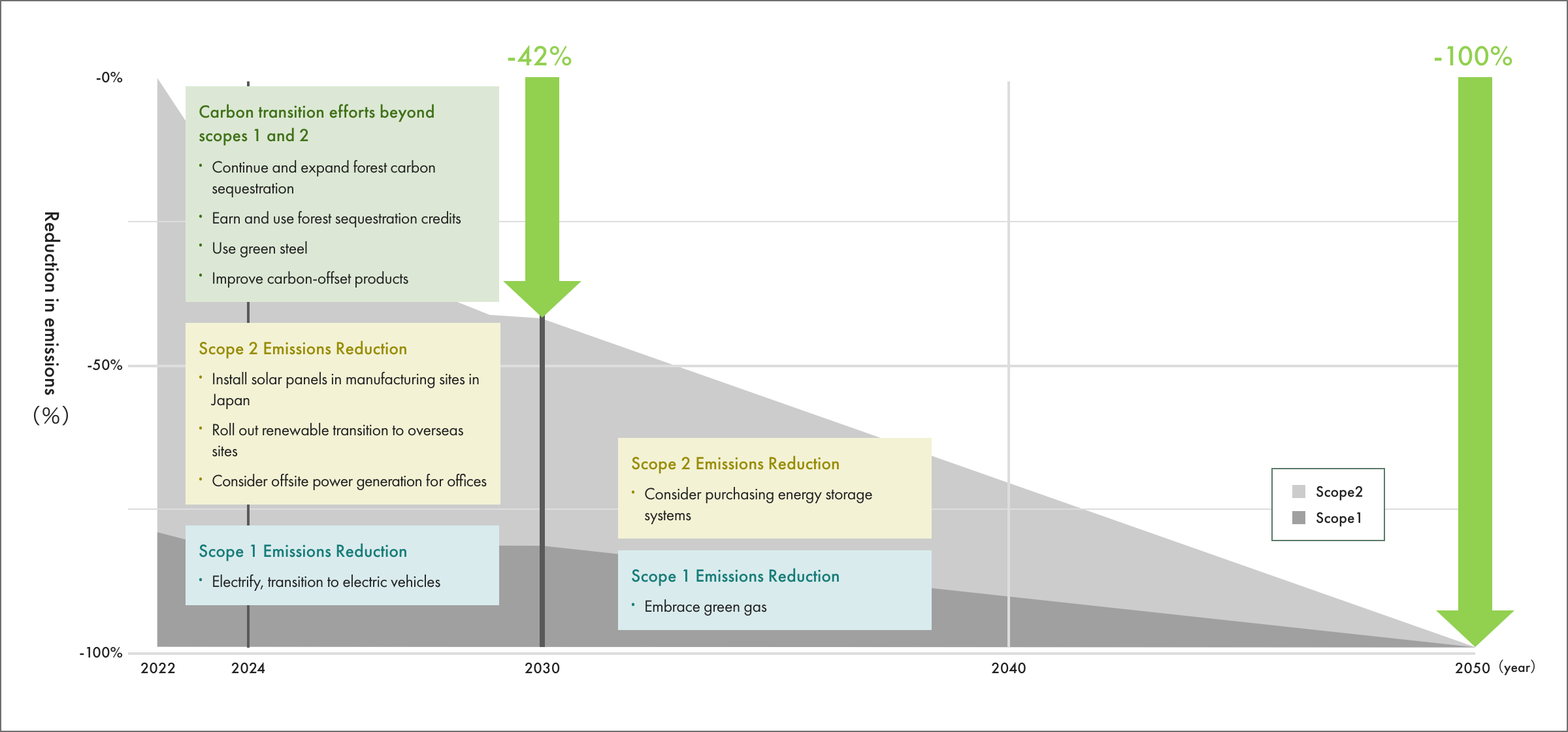
We have created a roadmap that illustrates the amounts of GHG emissions we will need to reduce to become carbon neutral by 2050.
One way we achieve this goal is to reduce our scope 1 and 2 emissions (emissions from our own operations or energy purchases).
Reducing such emissions is not the only way we drive the carbon transition. As an organization that uses forest resources extensively, we also use forest carbon credits to offset emissions associated with such resource use.
GHG Emissions Reduction
Renewables Shift
Electric power is the major source of our scope 1 and 2 emissions. We are working to shift our supply to renewable energy sources in order to reduce our own greenhouse gas emissions within our supply chain (scopes 1 and 2).
We shifted the following domestic sites to renewable energy between 2022 and 2024: the Mie Plant (which manufactures office furniture), KOKUYO Product Shiga (which makes notebooks), the Shibayama Plant (which manufactures room partitions), KOKUYO MVP’s Tottori Plant (which manufactures file binders), and The Campus (our core live office in Shinagawa, Tokyo).
Our commitment to a low carbon transition extends to our global operations. In India, solar power facilities have been installed at KOKUYO Camlin’s Tarapur and Patalganga plants.
Similarly, in 2025, a papermaking plant operated by KOKUYO Commerce (Shanghai) Co., Ltd., switched to renewable energy.
Thanks to these efforts, by 2025, as much as 42.4% of the energy consumed across KOKUYO Group (which includes overseas businesses) came from non-fossil fuel energy sources.
- Performance in 2027 commitment goals
- ESG databook > E-01 Responding to climate change > Power usage and ratio to fossil-fuel power
Engaging with Suppliers
For Scope 3 emissions (supply chain emissions), we have committed to goal related to total reduction of Scope 3 emissions and to a goal related to supplier engagement (getting suppliers to commit to reduction goals).
For total reduction, we asked our paper suppliers to give us primary data showing the emissions per unit of production of the paper we purchase from them, mindful of the fact that much of our Scope 3 emissions is derived from paper production and that we must therefore reduce emissions from this source.The paper suppliers were supportive of what we are trying to do. A number of them provided the data we requested.We also reached out to six furniture makers in our supply chain and asked them to support us in our efforts to reduce supply chain emissions. They agreed to do so.By staying in regular contact with suppliers, we gain a better idea of how much each supplier is emitting and what we can do to expedite reduction in our supply chain emissions.
As for supplier engagement, we have conducted a questionnaire survey and interviews among a sample of suppliers accounting for 80% of our procurement spending to understand their current commitment to reducing emissions.The results revealed that the suppliers (including those founded by KOKUYO Group) committing to science-based targets represent 84,800 t-CO2 of our Scope 3 emissions, which is 68% of our target of 125,000 t-CO2.We will continue engaging with suppliers to reduce supply chain emissions. In 2026, we will hold workshops with suppliers to resolve any technical issues with GHG calculation.
Actus Engages in 2025 Government Model Program for GHG Reduction
Actus, a group company that sells imported furniture alongside original brands of furniture and other interior goods, was experiencing a major hurdle in its supplier engagement efforts. Namely, the majority of its suppliers did not calculate their GHG emissions. Together with three of its suppliers, Actus enrolled on a model program run by the Ministry of the Environment (Government Model Program for GHG Reduction for the year ended March 2026). The purpose of the program was to establish a best-practice model for supplier engagement in the calculation and reduction of GHG emissions. During an eight-month period, Actus provided technical support to help its suppliers to calculate their GHG emissions and commit to reduction targets. By the end of this period, two of the three suppliers had calculated their emissions. The remaining supplier committed to reduction targets. The program involves engaging with suppliers to develop an emissions reduction plan focused on production processes. The plan might involve, for example, assessing the operational status of production machinery and apparatus, improving yield rate, and identifying ways to streamline workflows. The program offers a cost incentive for suppliers by focusing on initiatives for improving yield rate and reducing leftover materials (such as by changing criteria for material selection). Drawing on the insights gained from Actus’s participation in the program, we will roll out the initiatives to other suppliers in 2026 to further reduce our supply chain emissions.
Energy Saving
We are working to improve our energy efficiency alongside the transition to renewable energy sources.Energy intensity per unit of sales shows how much power we consume for every unit of sales value. This has continued to improve from a 2022 peak.
ESG databook > E-01 Responding to climate change > Energy intensity per unit of sales
For energy efficiency, we are rolling out LED lighting in our business locations. In 2025, KOKUUYO Logitem installed LED lighting on the ground floors of its distribution centers in the Greater Tokyo Area.The transition to LED has significantly contributed to energy efficiency. Facilities that converted to LED consume 70% less energy than before.
Product CO2 Visualization
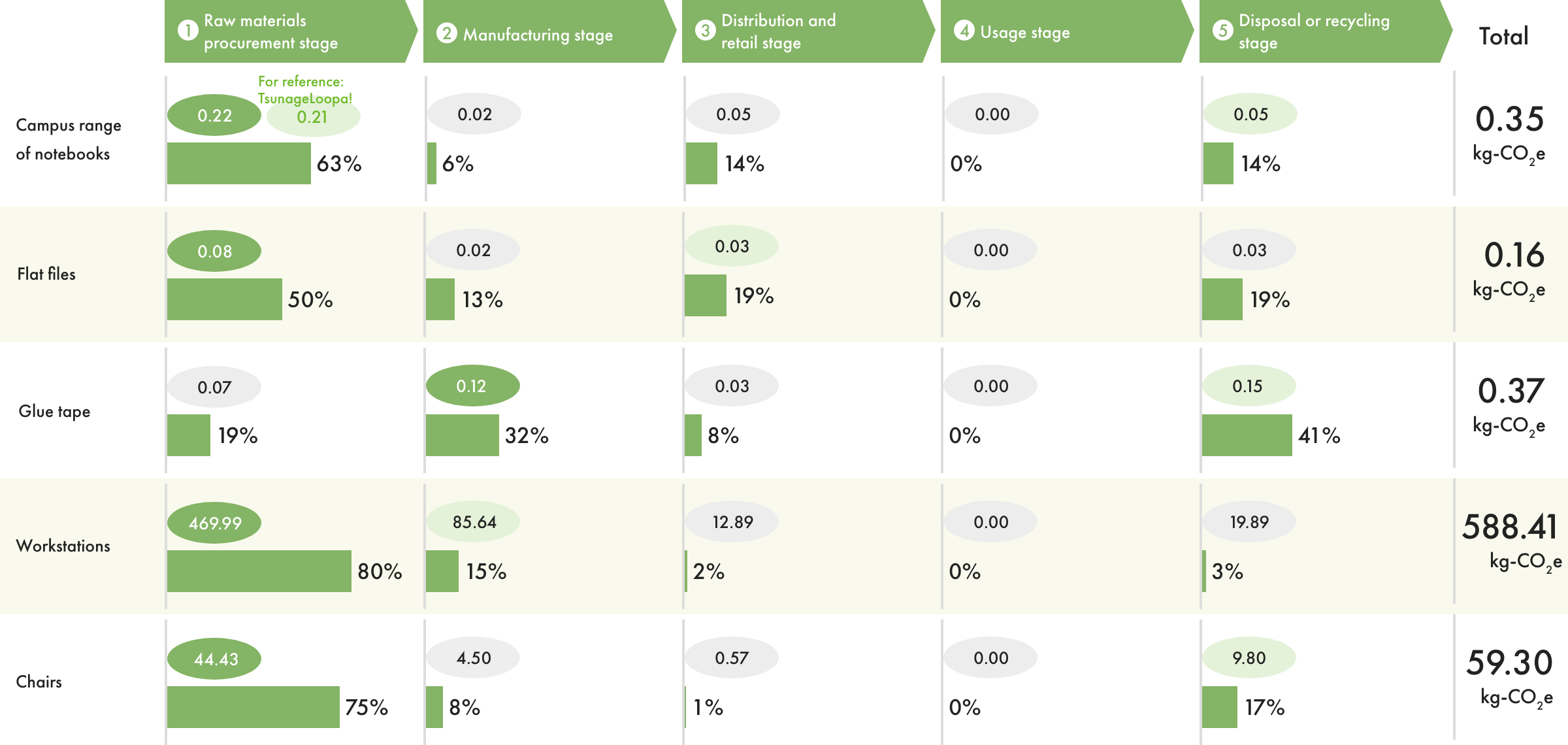
For our main products, we estimate the total product carbon footprint (PCF), meaning the carbon footprint generated across the whole of the product life cycle, from the procurement or raw materials to the time of final disposal or recycling.
From 2010 to 2023, we estimated total PCF independently. However, we now follow industry standards in our calculations in anticipation of rising demand for such calculation in green markets. For stationery and office supplies, we follow the calculation rules of the All Japan Stationery Association. For office furniture, we follow the calculation rules of the Japan Office and Institutional Furniture Association. These industrial associations issued these standards in March 2024 in response to the passing of the 2023 Act on Promoting Green Purchasing, which set out requirements related to the carbon footprint of stationery and office furniture.
As well as following these industry standards, we adhere to a PCF scheme that Osaka Prefecture launched in conjunction with the 2025 Osaka Expo. The scheme encourages companies that have best practices in calculating supply chain emissions.Its purpose is to encouraging companies to generate data that visually illustrates such emissions.
The results of this calculation exercise are as follows.
Carbon Footprint Calculation for KOKUYO Products
For reference: See here for the results of the “carbon footprint system pilot program” implemented in 2010 (run by METI and related ministries and agencies).