Sustainable Management
Balancing Social Value with Economic Value
Over the years, we’ve offered solutions for new ways of working, learning, and living through a process of first-hand experimentation in which we design experiences for customers through products and services.
Amid the plethora of socioenvironmental issues, we want to transform management systems and lead the way to a sustainable future with the support of all employees and Group businesses.
As more partner companies and customers engage with us, the circle of empathy will expand, sparking more innovation and solving more socioeconomic issues.
Material Issues and Performance
See Goals and Results: Strategic Theme 2.
Seeds of social value sown: Visionary idea (Mirai Yokoku) experiments
By 2030, we aim to have all of our new and existing businesses contributing to the solution of socioeconomic issues.
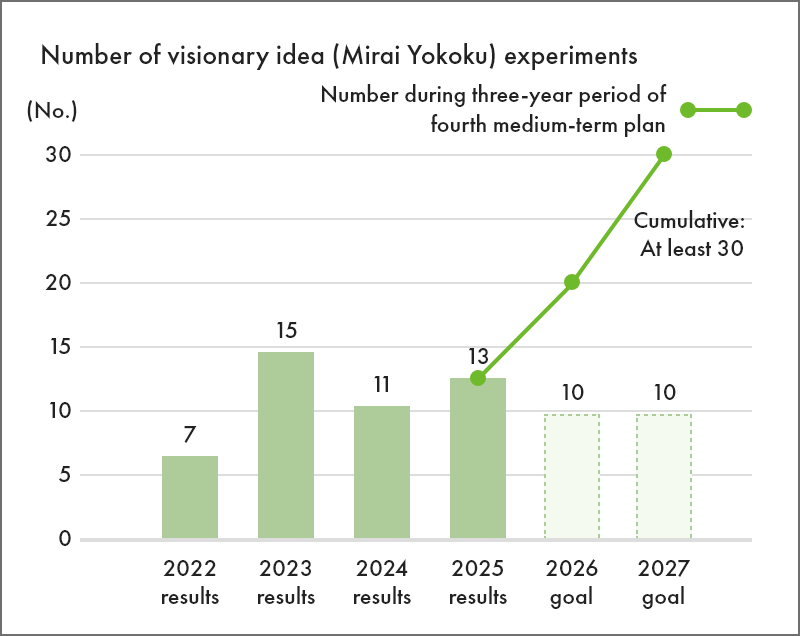
To that end, the fourth medium-term plan (2025 to 2027) commits us to raising the number of visionary idea (Mirai Yokoku) experiments we produce as part of our efforts to create new value for a “tomorrow you can’t wait for.” In line with this goal, we will commit resources in a sustained manner toward new experiments and entrepreneurship that will resonate with an increasing number of stakeholders and lead the way in tackling socioeconomic issues.
We will disseminate a logic model to give a clearer idea of how employees create, in their jobs, social value as well as economic value.
Over the three years of the fourth medium-term plan, we will take actions to achieve the following two goals: to produce 30 visionary idea (Mirai Yokoku) experiments and to have 100% of employees creating positive social impacts through their job.
In 2025, we produced 13 Mirai Yokoku experiments. One of these was a solution for organizational growth called Teamus. Teamus visually presents team data and delivers an intervention to increase the wellbeing of each team member and the productivity of the organization as a whole.
Besides Teamus, we implemented a number of multi-approach projects. One example was a workstyle solution that uses AI to streamline thinking processes and channel creativity. Another was a project for reusing Japanese timber in a way that creates value.
In this way, we continue to expand our horizons in engaging in social issues and creating new value in people’s work life, study life, and home life.
Awareness of Social Value Creation
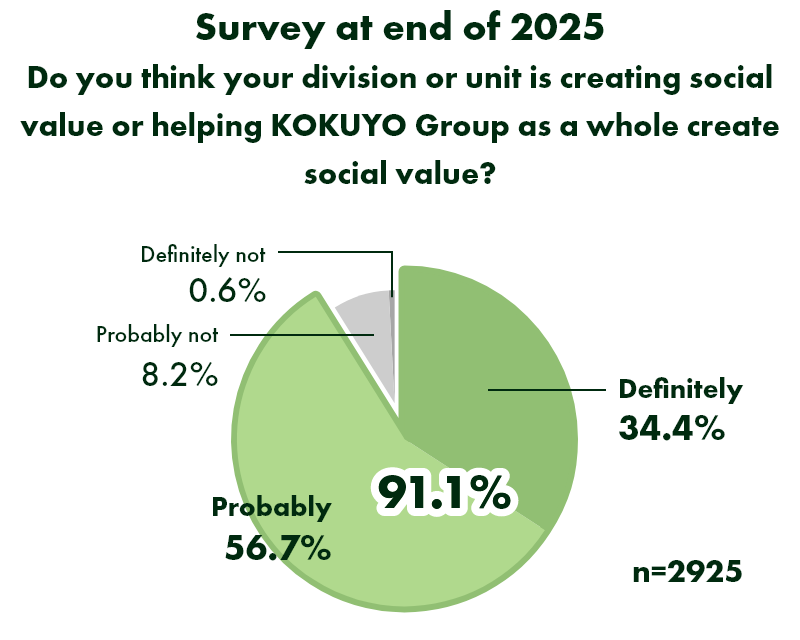
We carried out a questionnaire survey at the end of 2025 to understand the current level of awareness among our employees and to provide a reference point for future initiatives towards achieving our 2027 goal (as set out in the fourth medium-term plan) for 100% of employees to be addressing social issues through their job.
A total of 91.1% of our employees responded “definitely” or “probably” to a question asking whether they believe they are creating social value through their own job, suggesting that a growing number of employees have such an awareness.
We will implement measures to achieve the 2027 goal of 100% and carry out further surveys to understand how far awareness of addressing socioeconomic issues through their job has permeated our organization.
Actions
KOKUYO Marketing University and KOKUYO Marketing Graduate School
We developed these educational programs to help meet our goal of at least 30 visionary idea (Mirai Yokoku) experiments.
KOKUYO Marketing University gives younger employees a chance to learn customer-oriented problem-solving skills. KOKUYO Marketing Graduate School gives older (or mid-ranking) employees a chance to develop their long-term strategic thinking skills. Attendees, by honing their practical marketing skills, finish the course with the ability to lead new business projects that will be the seeds of our future success.
More than 320 employees have graduated from one of the two programs. Since graduating, they have taken on fresh challenges, driving our growth as an organization.
Disseminating Sustainability Across the Organization
We disseminate sustainability across our organization through an initiative called Sustainable Academia. As part of this initiative, we help each employee create social value in their job.
The fourth medium-term plan sets out a goal for 2027: for 100% of employees to be addressing social issues through their job.
In 2025, which was year 1 in the fourth medium-term plan, we continued our existing initiatives for material issues and also began informing employees about our general approach to sustainability and about our trailblazing examples of balancing social value with economic value.
One example was an event featuring a rescue-themed board game designed to inform employees about sustainable business management in a fun way. In another example, we published sustainability-related articles in our email magazine Sustainable Academia News. An example of an initiative for encouraging action was Sustainable Lab, which experiments with solutions for the sustainability-related issues employees have identified.