Sustainable Management
Process for Identifying Material Issues
Process for Identifying Material Issues
We follow the principle of dynamic materiality. This means we recognize that our material (sustainability) issues will change over time and periodically review and update them.
We conducted one such review in 2022. In that review, we decided to radically update the set of material issues, aligning them closer with our general strategies. During the review, we analyzed the gap between the future we envisage in our long-term vision and third medium-term plan and the current situation to identify the issues to be addressed. We then evaluated each issue’s economic and social importance to identify the material issues.
In 2025, we conducted another review to align the material issues with the fourth medium-term plan. In this review, we reassessed the activities we undertake for each material issue, the coverage of the actions, and the relative importance of each issue.
2020 materiality analysis
Learn about the process through which we identified material issues in 2020 and 2021.
-
STEP1
Identify ESG issues
-
STEP2
Analyze each issue’s impact on stakeholders and the company
-
STEP3
Submit to management for review
-
STEP4
Define material issues and goals
2022 revision
-
STEP1
Identify issues
The process of updating the material issues began with a review of the existing issues we had defined in 2020. In that review, we thought about the strategic issues we will need to address if we are to lead the way toward a self-directed, collaborative society and become a company in which no idea goes to waste. Through the review, we sought to identify a new set of material issues.
-
STEP2
Divide issues into economic and social categories
In light of the findings of the review conducted in Step 1 and the strategic themes outlined in the medium-term plan, we identified specific issues to make up for the inadequate elements in the previous materiality analysis.
We mapped out the material issues in the following process. First, we divided these issues into economic and social categories and plotted these issues onto the graph shown below. Then, we abstracted higher-level issues from clusters of the plotted issues.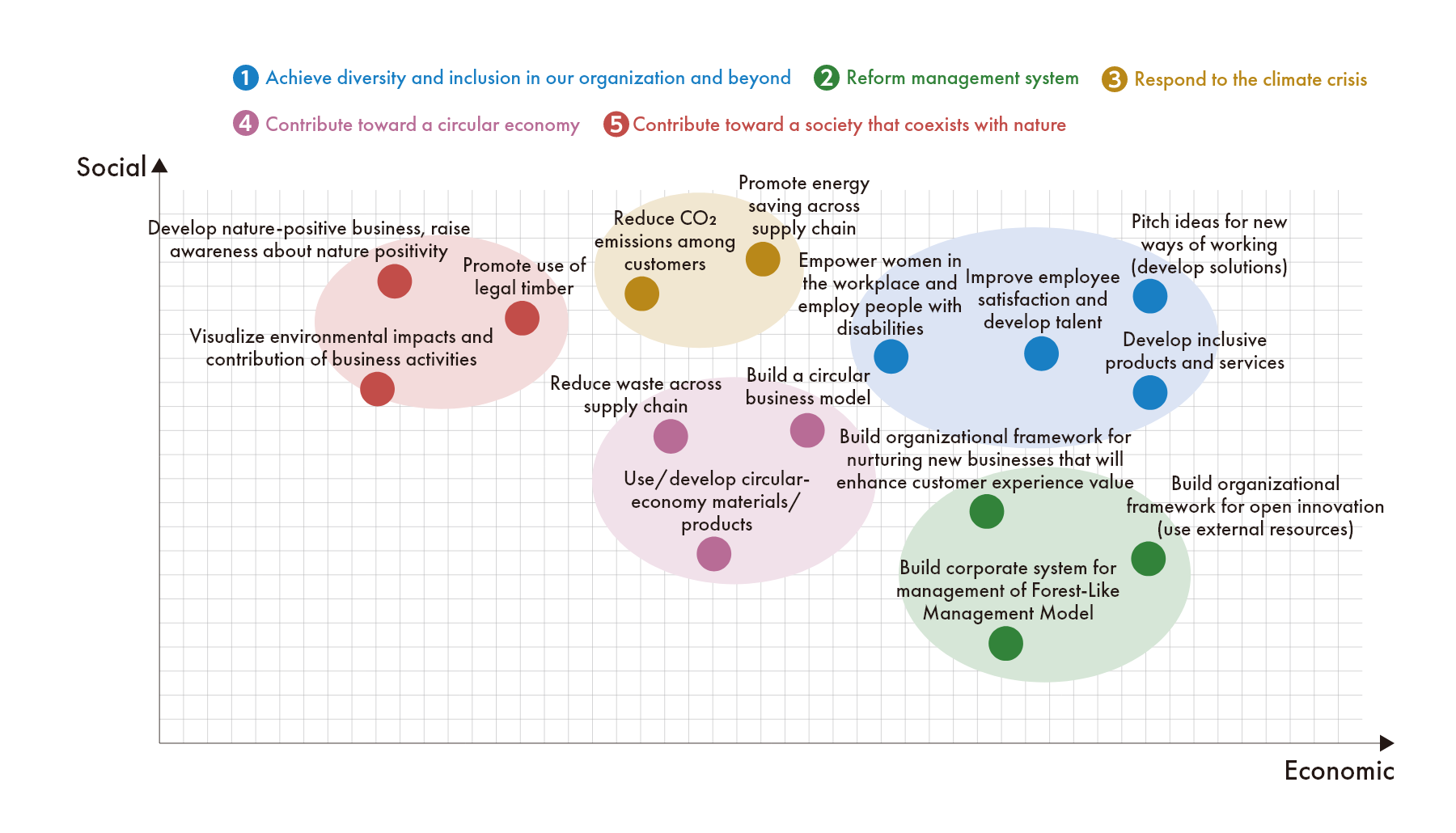

-
STEP3
Consider realigning material issues
Previously, our material issues were aligned with the SDGs. However, in this stage, we realigned them with the society we envisage. We then built an organizational framework for these realigned issues. We have set KPIs for our new set of material issues. For the time being, the KPIs are based on our vision for 2030.
-
2025 revision
We reviewed the scope of activities for “building a circular business model” previously grouped in the fourth material issue (“contribute toward a circular economy”) and separated it out as “promoting sustainable procurement”.